
Google Ads Google Ads aligned to the platform's current campaign mechanics, measurement signals and the business outcome behind the spend

Google Ads is configured only after the objective, target customer, conversion action and post-click experience are clear. Platform settings are treated as one part of the acquisition system, then validated against qualified leads, purchases or another agreed downstream outcome.

Discuss this service
Digital Marketing & Advertising
The opportunity

Make the next decision with clarity.

Campaign spend is not linked to reliable conversion measurement. This is especially relevant when considering google ads.

Traffic or lead quality does not match the commercial objective.

01

Cleaner campaign measurement

Cleaner campaign measurement

02

More disciplined budget allocation

More disciplined budget allocation

03

A clearer explanation of where performance is being lost

A clearer explanation of where performance is being lost

The approach

From clarity to execution.

A deliberate implementation process, adapted to your business instead of a generic playbook.
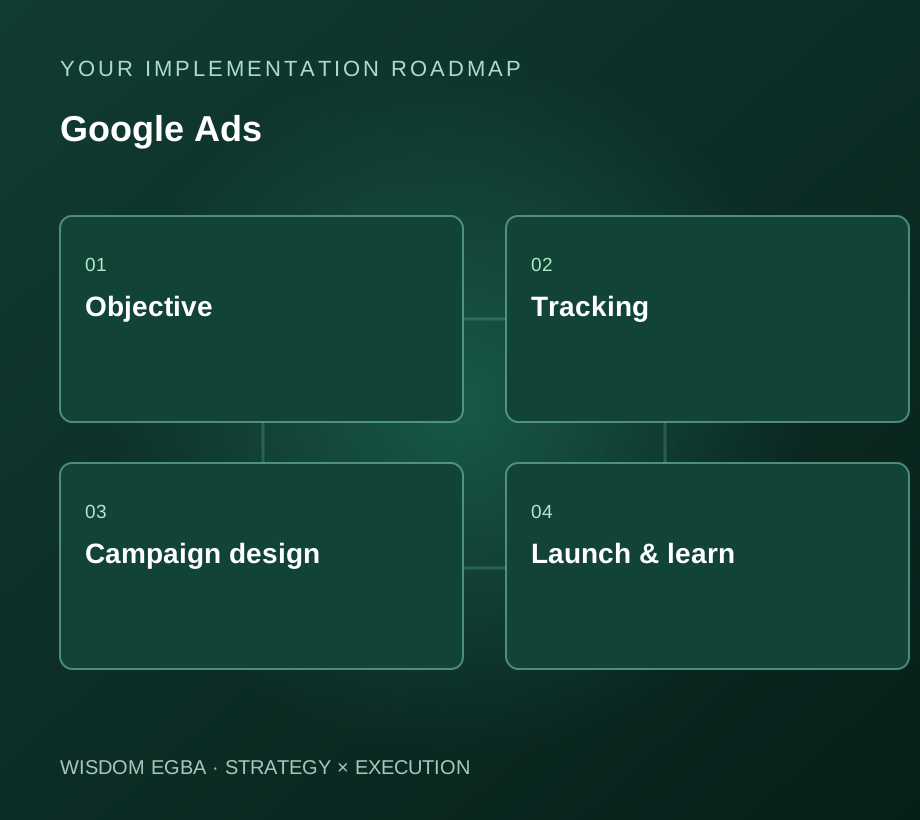
Original Google Ads process infographic showing the key implementation areas

Define the commercial action, conversion and acceptable measurement standard.

What you receive

Real work. Clear handover.

Deliverables are agreed around your requirements. Every output should have a purpose and an owner.

Campaign/account architectureIncluded
Conversion-measurement planIncluded
Audience and creative requirementsIncluded
Launch or remediation configurationIncluded
Performance review and optimization actionsIncluded
SPECIALIST IMPLEMENTATION

How we implement Google Ads.

Connect people actively searching for a solution with a relevant offer and track what happens after the click. Campaign selection depends on business type, eligibility and the economics of the sale.

Configuration & execution

  • Review the website, search intent, product/service offer, landing pages and conversion readiness before launching.
  • Configure account access, billing, campaign settings, relevant consent controls, Google Tag Manager and Google Analytics 4 where appropriate.
  • Set up meaningful conversion events, enhanced or offline conversions where permitted, and verify attribution before relying on automated bidding.
  • Structure Search campaigns around intent, keywords, exclusions, ad groups, responsive assets and relevant destination pages. Evaluate Shopping or Performance Max only when feeds and goals justify them.
  • Use a controlled testing and optimisation cycle: search terms, creative relevance, landing-page quality, spend distribution, lead quality and conversion data.

Audience, relevance & quality

  • Match keyword themes and search intent to the customer's stage of decision.
  • Use geography, language, schedule and device settings only where relevant to serviceability.
  • Maintain negative-keyword and exclusion reviews to reduce irrelevant traffic.
  • Separate leads from qualified leads, completed sales or verified offline conversions in reporting.
Tracking & evaluation

Track relevant enquiries, qualified appointments, purchases, customer acquisition cost and conversion value where reliable data is available.

AI & responsible optimisation

Google's automated bidding, responsive assets and other AI-assisted features can be evaluated using trusted conversion signals and human review; never assume automation will compensate for poor targeting or missing tracking.

Practical example

A Lagos property developer could compare specific estate-location searches against general land-investment queries, then qualify budget and inspection readiness in its CRM.

Illustrative scenario; not a claim about a named client's results.
Discuss this implementation
Let's work together

Ready to make meaningful progress?

Start a conversation